
If you’ve recently moved into a home connected to a heat network, you might be wondering why you don’t have a big white gas boiler in your kitchen. Instead, you most likely have a heat interface unit (HIU) – a clever bit of kit that looks like a boiler but acts like a ‘bridge’, bringing heat from a central heat source directly to your heating (radiators or underfloor heating) and hot water (taps, showers) outlets.
Because heat networks are communal systems, knowing who to call when you have a question or issue can feel a bit like a puzzle. With , there is more clarity needed than ever to understand your rights and our responsibilities.
To help make heat network responsibilities clearer, here’s our plain-English guide to who’s who on your heat network*.
*Our guide to who’s who explains the typical roles and responsibilities, but every heat network is set-up slightly differently, so the right contact can vary depending on your development. In many cases, Insite Energy may be your first point of contact and we’ll either help resolve your query or direct it to the right organisation.
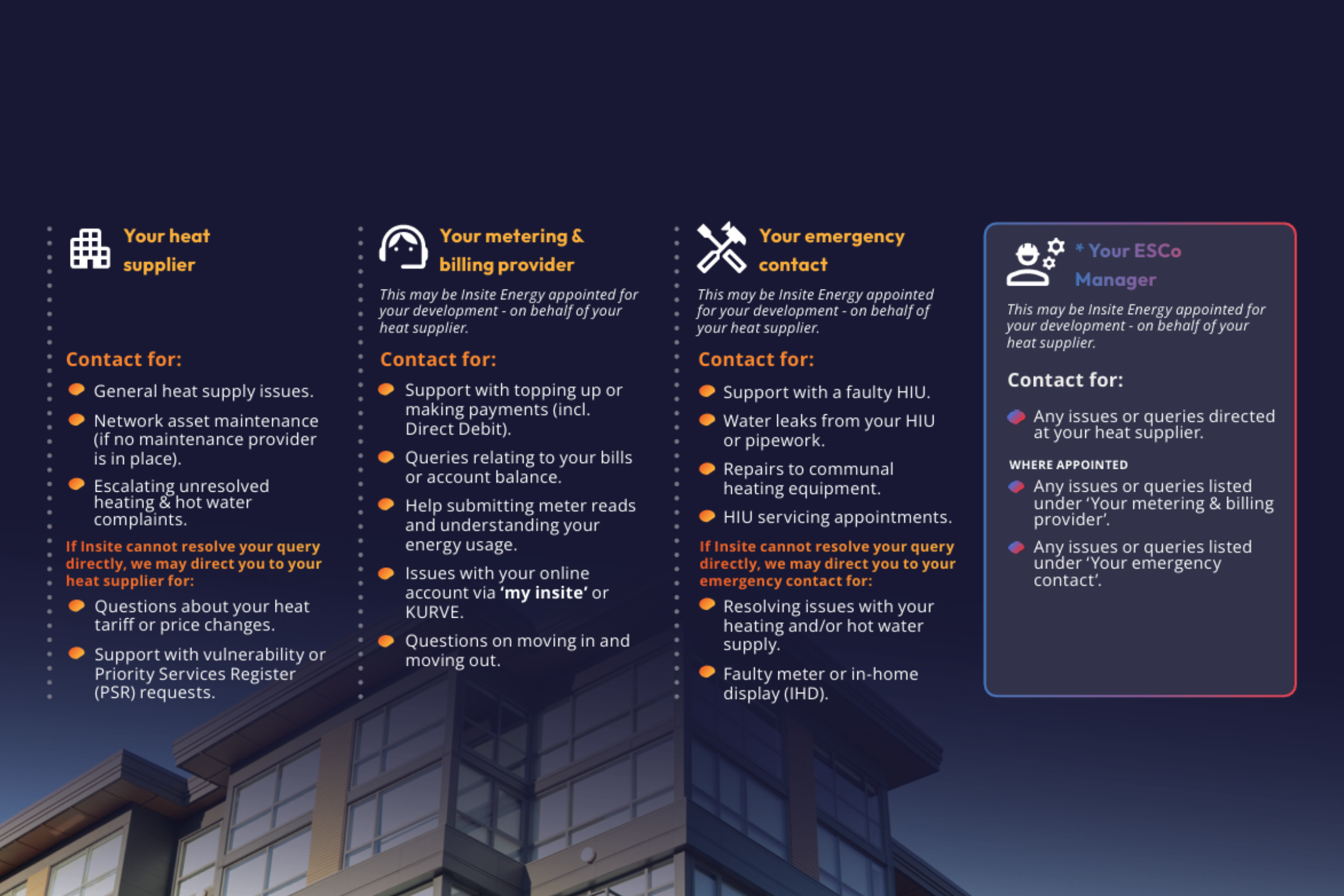
1. The heat supplier (The decision maker)
Your heat supplier is the organisation you have a heat supply contract (HSC) or leasehold agreement with. This is usually your landlord, managing agent, or Energy Supply Company (ESCo). Under new Ofgem rules, they are legally responsible for your heating & hot water supply.
- Their responsibilities: Your building landlord owns the property and acts as the heat supplier unless they appoint a managing agent to handle the network’s daily operations and responsibilities on their behalf. Through ongoing operation and maintenance of the energy centre, they ensure you receive reliable heating & hot water supply. They manage the “bulk fuel procurement” (buying the energy for the whole building) and set the energy tariffs you pay to cover the cost of running the network.
- What this means to you: They must treat customers fairly, provide clear notice of price changes and transparent billing, and are required to provide additional support to residents in vulnerable situations through a priority services register (PSR).
2. The metering & billing provider (That’s us!)
Providing monthly bills or access to a pay-as-you-go (PAYG) system for residents can be managed by the heat supplier, ESCo Manager or by an appointed metering & billing provider, like Insite Energy.
- Their responsibilities: They read your energy meter to gather your energy consumption data, calculate your bills, process your payments or top-ups, provide customer support for any account-related queries, and support your heat supplier in the notification and application of tariffs.
- What this means to you: If you have a question about a payment, your balance, or managing your online account via ‘my insite’ or KURVE, we are your first port of call.
Not sure whether you need to contact us? If you’re an Insite Energy resident, your ‘my insite’ account is often the quickest place to start for top-up, payment and account information. Once registered, you can check your balance, view your payment history, access annual account statements, FAQs, energy saving tips and more, helping you find answers faster before raising a query.
3. The maintenance provider (The “Fix-it” team)
These are the engineers who keep the heat network running. This could be your heat supplier, or a separate maintenance company they’ve appointed.
- Their responsibilities: They look after the HIU and metering equipment in your home, and the communal heating assets throughout the building. If there is a building-wide outage, they get things back up and running as quickly and safely as possible.
- What this means to you: Under new 2026 standards, maintenance must be proactive to prevent outages. Strict targets will also come into place to ensure your heating & hot water supply is reliable and efficient.

An engineer servicing a heat interface unit (HIU) located in a resident utility cupboard. Your building’s maintenance provider is responsible for maintaining this equipment.
4. The resident (You)
You play a vital role in keeping the network healthy.
- Your responsibilities: Keeping the heating and metering equipment in your property (such as the HIU, radiators, thermostats, pipework) in good working order sits with you. We recommend checking your tenancy or leasehold contract to ensure you’re familiar with who’s responsible for the maintenance of your HIU.
- What this means to you: To keep the network running efficiently and compliantly with Ofgem regulations, you’ll occasionally need to provide access for engineers to service the equipment in your home and keep all equipment free from damage.
The ESCo Manager (Heat network specialists)
As landlords manage all elements of a building, they may choose to appoint a specialist to oversee the heat network on their behalf. In these cases, Insite Energy may be appointed as your ESCo Manager.
- Their responsibilities: If Insite are your ESCo Manager, we ultimately manage all aspects of the heat network on behalf of your heat supplier. This includes taking care of the incoming energy supply, financially managing the heat network, calculating and setting tariffs, and managing the maintenance of the heat network, including the metering system. The ownership of the heat network however, remains with the heat supplier
- What this means to you: Think of the ESCo Manager as your one-stop point of contact for everything and anything relating to your heating system.
Where to find your specific contacts
As every development is managed slightly differently, the specific list of providers and their heat network responsibilities will be unique to your home. You can find out exactly who is who and how to reach them by:
- Checking the welcome pack from your landlord: Check your inbox for any tenancy documents or other communications sent to you by your landlord when you first moved in, as these may contain specific emergency contact information for your building.
- Using our website: If you’re a resident on a heat network with services provided by us, visit our ‘Find your home’ page and search for your postcode or development name. As well as containing a welcome brochure with key information about your heat network, your development page lists out your heat supplier, metering & billing provider, and emergency contact, if available, along with their contact details.
No heating or hot water?
Before reaching out to the relevant contact, follow our quick troubleshooting guide to rule out common issues.
Useful to know: If you’re aware of three or more properties suddenly experiencing the same heating or hot water issue at the same time, please mention this when contacting the emergency contact for your building. This may suggest a wider site issue and could help them allocate the right engineer more quickly.