
Your tariff is broken down into two elements:
Unit rate: Your unit rate is the cost per kilowatt-hour (kWh) of energy consumed in your home, along with any associated heat
losses.
Total energy charge (p/kWh) = units used (kWh) x charge per unit (£)
Daily standing charge: Your DSC is a fixed daily fee that covers the operational costs of running the heat network. This charge ensures the network operates reliably for residents all year round.
Total standing charge = days in the billing period x daily standing charge
Your tariff is regularly reviewed every 6-12 months to ensure the price is fair and any fees charged do not exceed the cost of providing energy to your home. You will receive 31 days’ notice ahead of any increase in rates, and at least 7 days’ notice where there is a decrease. We’re unable to change your tariff unless instructed by your heat supplier.
Your current tariff can be found on your bill, under ‘My Account’ in ‘my insite’, and on your pay-as-you-go in-home display (IHD).
To view a breakdown of the tariff specific to your scheme, please read the ‘Tariff breakdown’ document, downloadable from our development directory.
Your heat supplier pays the cost of delivering energy to all connected properties. Insite Energy work on behalf of your heat supplier to provide metering & billing services to residents at your development. We are unable to change your tariff unless instructed to do so by your heat supplier.
Your heat supplier has instructed us to help calculate your tariff and recover the costs of supplying energy to each individual home, including yours, without making a profit.
Your tariffs are set and regularly reviewed by your heat supplier to ensure prices remain fair to all residents. The money you pay through your unit rate and daily standing charge contributes toward the overall energy costs.
To view a breakdown of the tariff specific to your scheme, please read the ‘Tariff breakdown’ document, downloadable from your development page.
To find out more about Insite Energy’s role in your heat network, see our ‘About us’ page.
Depending on the make and model of your heat interface unit (HIU), there may be a built-in ‘Keep Warm’ function. This allows for a constant trickle of hot water to flow through your HIU, keeping the plate heat exchanger within warm and ready to supply you with instantaneous hot water when you need it.
The HIU is fully insulated to minimise any heat loss and ensure it is as energy efficient as possible. Without this function, hot water delivery time would be significantly delayed.
The continuous movement of water and heat on the network side of your HIU also ensures the system circulates clean water to avoid any issues with system degradation, such as silt or limescale build-up. If a system doesn’t have this circulation, water quality can reduce, in term negatively impacting the performance and efficiency of the system. As a result, repair works may then be required to drain the entire system, which will have a high cost and environmental impact.
The same functionality and benefits apply for cooling interface units (CIUs), where a ‘Keep Cool’ function may exist to keep the plate cool.
These functions may result in a small amount of kilowatt-hour (kWh) consumption per day (<2 kWh).
If you still have a concern about your energy usage, please get in touch.
According to Ofgem, the typical household in the UK uses 6,000 – 14,000 kWh of gas in a year. Heat networks are an efficient, low carbon method of delivering heat to buildings, so most heat network residents should see lower consumptions than this.
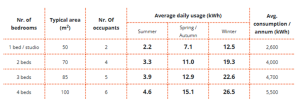
To give you an idea of how much energy you should be consuming based on the size of your property, we’ve pulled together the below averages.
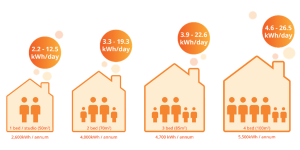
This data is based on an industry standard for energy use within residential dwellings and should only be used as an indicator. Your usage may differ based on the time of year, your building (size, fabric and components installed) and usage habits (how many people live in your home, how often you shower, the temperature of your rooms, etc.). The daily usage bracket has been calculated using estimate consumption from June (lowest consumption) to January (highest consumption).
If you think you’re paying too much for your energy usage, please consider the following potential factors which may have resulted in an increase in your usage:
- There has been a recent change in the weather
- You’ve recently had visitors to stay
- Your personal circumstances have changed
- Your tariff has recently been revised
If your energy consumption still seems higher than expected, here are some steps you can take to check and manage it:
1. Reduce your energy consumption
Did you know that turning down your heating by 1°C can save up to 10% off your bill? You can also save energy by washing up in a bowl and replacing your showerhead with a more efficient one. These and many more tips can be found in our resident guide to heating & hot water. You’ll find energy saving tips from page 13.
2. Request a consumption report
We can provide you with a detailed usage data report, which will show you your energy consumption over a specified period using automatic meter reads sent to us. This will hopefully help you understand your usage better but may not give you answers as to why your usage is high. Please get in touch with us to request a report.
3. Arrange for your system to be serviced
If you’re still concerned about your usage, we recommend contacting your heat supplier about getting your heat interface unit (HIU). You can find your heat supplier’s contact details by searching for your postcode or building name in our development directory.
4. Find out what financial support is available to you
If you’re struggling to pay your bills, we recommend you do the following:
• Set-up a payment plan Direct Debit via ‘my insite’ or by getting in touch;
• Contact your heat supplier;
• Consult our financial support and guidance for residents help sheet or;
• Get in touch with us to explore your options.
If you feel none of this relates to you and you’re still concerned that you’re spending too much on your heating & hot water, take a look at our energy saving tips.
Alternatively, if you’re concerned your meter isn’t correctly recording your consumption, please get in touch.
If you’re a pay-as-you-go (PAYG) resident, your daily standing charge is deducted automatically from your balance every day, but the timing of this depends on the type of PAYG system you have.
- If you’re a Guru Hub I/II or Secure PAYG resident, the charge is taken gradually throughout the day.
- If you’re a KURVE PAYG resident, the full daily standing charge is deducted in one go around midnight.
From learning more about what a heat network is to understanding what those numbers on your radiator valves mean, our resident guide to heating & hot water delves into it all. You can download it here. You’ll find energy saving tips from page 13.
You can also visit Energy Saving Trust and Citizens Advice for some independent advice on how to reduce your energy spend.
As your heating & hot water are measured through the same energy meter, it is not possible to view them separately.
However, a good way to get an idea of your baseline hot water use is to review your summer consumption, when your heating is typically off. Any additional usage you see during the colder months will mainly be from heating.
Unlike gas or electricity suppliers, heat networks do not offer ‘time-of-use’ or ‘variable’ tariffs. This means that your heating & hot water costs the same no matter the time of day.
Because your heat is supplied through a shared network system, the tariff is set by your heat supplier based on the cost of producing and distributing that heat, not by when you use it.
Tips on how to manage your usage and save energy, can be found in our resident guide to heating & hot water. You’ll find energy saving tips from page 13.
If your home is connected to a communal heat network, your electricity, water, and heating & hot water will be provided to you as separate utility services, which is why you may be charged individually for each.
Your electricity bill covers the electricity used in your home, such as for lighting, powering appliances (like fridges, washing machines, TVs), charging devices, and cooking. Your ‘potable’ water bill covers the water supplied to your property, typically used in your bathroom(s) and kitchen. Neither of these charges cover the energy used to heat your home (via radiators or under floor heating) and water supply.
On a communal heat network, your heating & hot water is provided through a shared heating system serving your building. Unlike electricity, where you can usually choose your supplier, the heat supplier looks after the entire heat network, so individual residents cannot choose or switch to a different heat supplier. The cost of the heat you use is therefore charged to you separately by your heat supplier. Insite Energy acts as the metering & billing agent on behalf of your heat supplier, so any bill or pay-as-you-go charges from us relate specifically to the heating & hot water supplied through your building’s heat network.


Can’t find what you’re looking for?
If you still need help, please give us a call. To find your dedicated scheme phone number, simply search for your development name or postcode in the top search bar.
You can also contact us via one of our webforms for support with your Insite account.